

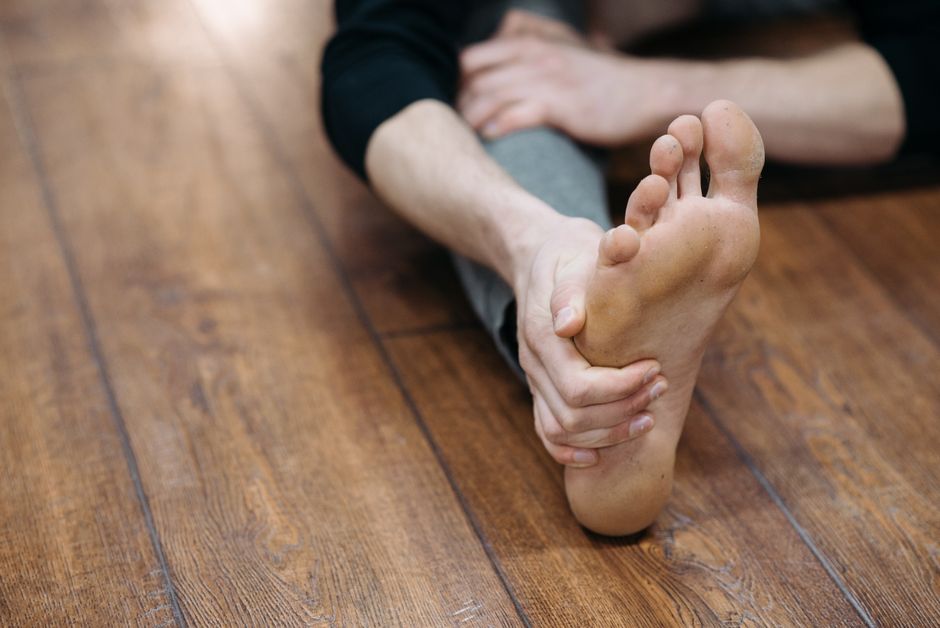
If you have been sitting for most of the workday and noticed that your feet feel stiff when you finally stand up, or that your ankles wobble a little on uneven ground, you are not imagining it. Prolonged sitting reduces the neuromuscular demand on the small intrinsic muscles of the foot, and over weeks and months those muscles quietly lose strength and responsiveness. The result shows up as fatigue on short walks, reduced balance, and a slightly higher risk of rolled ankles or overuse injuries when you do exercise.
The good news is that foot strength responds quickly to consistent, targeted movement. You do not need special equipment or a gym membership to make real progress with foot strength exercises during and after desk work. The five drills below are arranged progressively, starting with gentle mobility and building toward single-leg stability challenges, so you can work at the level that suits you today and advance steadily.
For a deeper look at how desk posture affects the whole kinetic chain, Stretching for Desk Posture: Five Moves That Reverse Rounded Shoulders in 10 Minutes pairs well with this routine.
Why Desk Work Quietly Undermines Foot Stability
Your foot contains 29 joints and more than 100 muscles, tendons, and ligaments (American Orthopaedic Foot and Ankle Society). When you sit for hours, those structures remain in a fixed, low-demand position. The tibialis posterior, flexor digitorum brevis, and the intrinsic toe muscles that help you balance and propel each step become underused. Research published in the Journal of Electromyography and Kinesiology suggests that prolonged static postures reduce muscle activation patterns and can accelerate functional decline in supporting musculature, even without pain.
Weak foot muscles do not just affect your feet. Because your feet are the foundation of every standing movement, reduced stability there can shift load unevenly up through the ankles, knees, and hips. If you have also noticed tight hips after long sitting days, Mobility Drills for Tight Hips That Sabotage Your Walking Consistency addresses that upstream problem directly.
The Five Progressive Drills
Drill 1: Seated Ankle Circles (Mobility Foundation)
Why it works: Restores synovial fluid circulation in the ankle joint and reactivates the peroneal and calf muscles before loading.
How to do it: While seated, lift one foot slightly off the floor. Draw large, slow circles with your toes, moving through your full range of motion. Complete 10 clockwise, then 10 counterclockwise. Switch feet.
Frequency: Do this at the start and end of your workday, and any time you have been sitting for more than 60 minutes.
Beginner note: If your ankle feels stiff or clicks, start with smaller circles and gradually increase the range over several days.
Drill 2: Towel Toe Scrunches (Intrinsic Muscle Activation)
Why it works: Targets the intrinsic foot muscles that support your arch and are most likely to weaken during sedentary periods.
How to do it: Place a small towel flat on the floor. Barefoot, use only your toes to scrunch the towel toward you, hold for two seconds, then spread the towel back out. Do 3 sets of 10 repetitions per foot. If you have no towel, practice picking up marbles or small objects with your toes.
Progression signal: When this feels easy and your arch lifts clearly during the scrunch, move to Drill 3.
Drill 3: Short Foot Exercise (Arch Strength Builder)
Why it works: The “short foot” drill, widely used in physical therapy settings, trains the longitudinal arch without curling the toes. It isolates the deep intrinsic muscles more effectively than toe curls alone.
How to do it: Stand or sit with your bare foot flat on the floor. Without curling your toes, try to shorten the distance between your heel and the ball of your foot by gently doming your arch upward. Hold for 5 to 10 seconds, then release fully. Do 3 sets of 8 per foot.
Common stumbling block: Many people curl their toes instinctively. Rest a finger lightly on your toes as a reminder to keep them long and relaxed.
Drill 4: Heel and Toe Raises (Calf and Tibialis Activation)
Why it works: Standing calf raises strengthen the gastrocnemius and soleus, which work with the intrinsic foot muscles to manage landing forces and push-off during walking. Adding a tibialis raise (lifting the front of the foot) balances the anterior and posterior chain around the ankle.
How to do it:
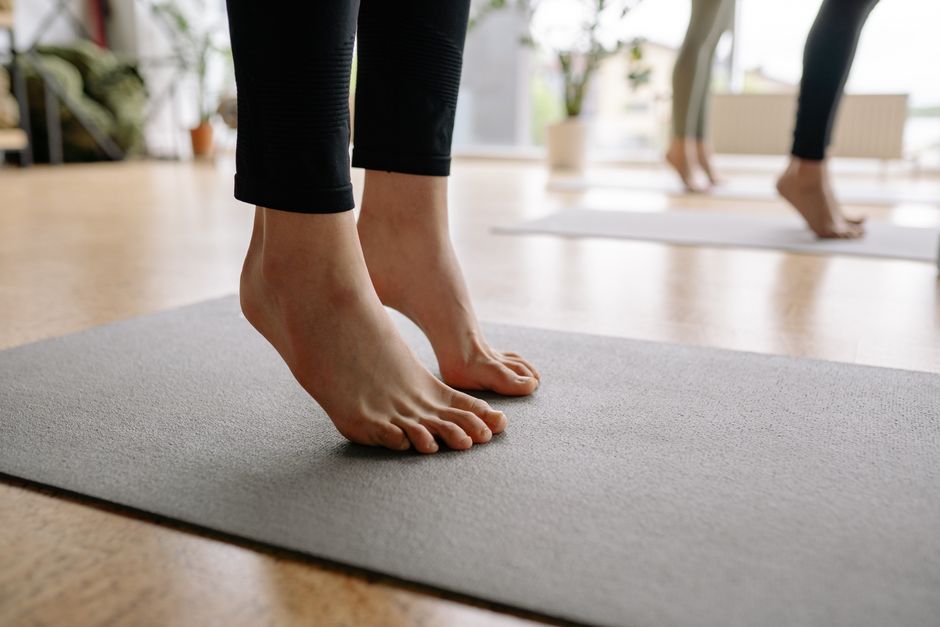
- Calf raises: Stand with feet hip-width apart, rise onto your toes slowly (2 counts up, 2 counts down). Do 15 repetitions. Hold a wall or desk edge lightly for balance only.
- Tibialis raises: Stand with your back lightly against a wall, heels about 6 inches from the wall. Lift the front of both feet off the floor as high as comfortable. Do 15 repetitions.
Frequency: Once or twice daily. For a broader lower-body context, Leg Strength Without a Gym: Five Progressive Bodyweight Drills for Stairs, Walking, and Daily Life builds naturally on these movements.
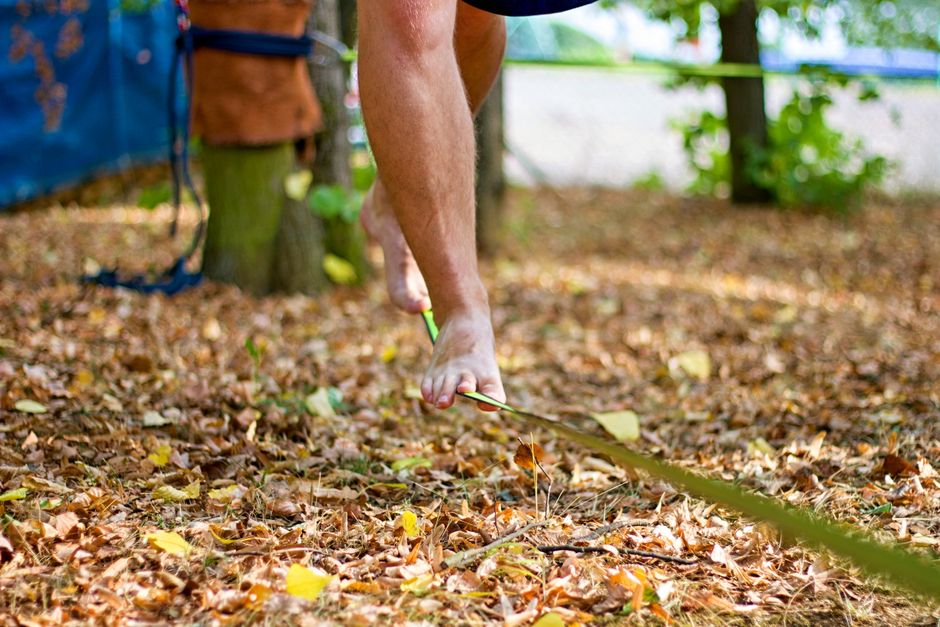
Drill 5: Single-Leg Balance Hold (Stability Integration)
Why it works: Combines everything above into a real-world balance demand. Research published by the British Journal of Sports Medicine has linked poor single-leg balance with increased lower-limb injury risk, and this drill directly trains the foot, ankle, and lower leg coordination needed for walking on varied surfaces.
How to do it: Stand on one foot, knee very slightly bent, for 20 to 30 seconds. Keep your eyes focused on a fixed point at eye level. Switch sides. Do 3 rounds per foot.
Progressions, in order:
- Eyes open on a flat surface
- Eyes closed (significantly harder)
- Eyes open on a folded towel or cushion for an unstable surface
Safety note: Stand near a wall or counter. Do not progress to eyes-closed or unstable surfaces until you can hold the eyes-open flat version comfortably for 30 seconds.
If you enjoy outdoor walking as part of your routine, Trail Walking vs. Flat Pavement: Which Surface Builds Better Foot Stability and Everyday Strength explains how uneven terrain adds a natural progression to single-leg stability work.
How to Build This Into Your Day
You do not need a separate workout session. Here is a realistic daily structure:
- Morning (3 to 5 minutes): Ankle circles + short foot exercise while coffee brews or during a standing call.
- Midday break (5 minutes): Heel and toe raises + towel scrunches at your desk.
- Evening (3 to 5 minutes): Single-leg balance holds while brushing your teeth or waiting for dinner.
Consistency across two to four weeks matters far more than intensity. Most people notice improved stability and less end-of-day foot fatigue within three to four weeks of daily practice.
One Action to Start Today
Choose one drill, ideally the ankle circles or the short foot exercise, and commit to it for the next five days. Add a second drill only when the first feels completely familiar. Small, consistent steps build lasting foot strength far more reliably than doing all five perfectly once and then forgetting them.
For more whole-body movement ideas that fit a desk worker’s schedule, explore the Home Workouts That Fit Unpredictable Family Schedules guide, or subscribe to the Clean Body Mentor newsletter for practical weekly wellness guidance delivered to your inbox.
This article is for general educational and informational purposes only and is not a substitute for medical advice, diagnosis, or treatment. Health needs vary by individual. Consult a qualified healthcare professional before making significant changes to your diet, exercise routine, supplements, medication, or treatment plan, especially if you have a medical condition, are pregnant or breastfeeding, take medication, or have concerns about your symptoms.
Sources
- American Orthopaedic Foot and Ankle Society. Foot and ankle anatomy overview. (aofas.org)
- Headlee D.L. et al. (2008). Fatigue of the plantar intrinsic foot muscles increases navicular drop. Journal of Electromyography and Kinesiology.
- Bahr R. et al. (2017). Prognostic factors for recurrent ankle sprains. British Journal of Sports Medicine.
- Jam B. (2006). Evaluation and retraining of the intrinsic foot muscles. Advanced Physical Therapy Education Institute.


