

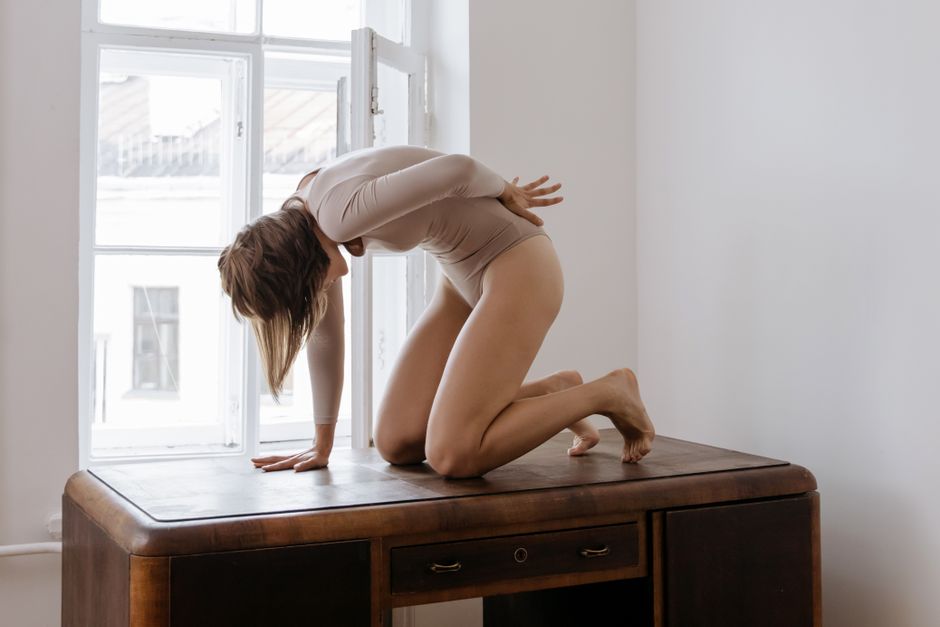
You have not changed what you eat, you drank plenty of water, and yet by early afternoon your stomach feels tight, full, and uncomfortably gassy. If this sounds familiar and you spend most of your day at a desk, the problem may not be in your food at all. It may be in the way you are sitting.
Digestive bloating from desk posture is more common than most people realize, and the mechanical reason behind it is straightforward enough to act on right now.
How Slouching Compresses Your Digestive Organs
When you round forward at the shoulders and let your head drift toward the screen, your ribcage drops toward your pelvis. That collapse reduces the vertical space inside your abdominal cavity by several centimeters. Your stomach, small intestine, and large intestine are soft, flexible structures that respond directly to that pressure.
The result is a slower process called peristalsis, the wave-like muscle contractions that move food and gas through your digestive tract. Research published in the Journal of Gastroenterology and Hepatology suggests that increased intra-abdominal pressure can slow gastric emptying and contribute to symptoms like bloating, distension, and discomfort. A compressed gut also makes it harder for trapped gas to migrate toward the exit, so it sits and accumulates.
Your diaphragm is involved too. Slouched posture limits the downward movement of this large breathing muscle, which means you tend to take shallow chest breaths rather than full belly breaths. Shallow breathing reduces the natural massaging action that diaphragmatic movement provides to your digestive organs. If you want to explore this angle further, Digestive Bloating From Shallow Breathing and Rounded Posture: Why Breathwork Beats Food Swaps for Afternoon Relief goes deeper into the breathing side of this equation.
The good news is that you can interrupt this cycle during a short break, no gym required.
Why Movement Beats Food Swaps Here
The instinct when bloating hits is to audit your last meal. But if the root cause is positional compression and reduced movement, swapping broccoli for spinach is not going to help. Digestive Comfort at Your Desk: Why Movement Breaks Stop Bloating Better Than Food Swaps makes this case clearly: restoring physical space and stimulating peristalsis through movement addresses the actual mechanism rather than circling around it.
That said, stress also plays a role on high-pressure workdays, because the nervous system can tighten the gut independently of posture. If you notice your digestive bloating spikes on your most stressful afternoons, How Digestive Bloating Worsens on Stressful Days and What to Eat When Your Gut Feels Stuck covers that overlap in practical detail.
For now, the fastest tool you have is movement at your desk.

Four Stretches That Decompress Your Abdomen at Your Desk
These four movements target the specific postural pattern that compresses your digestive organs: a flexed spine, a collapsed chest, and a shortened front body. You do not need a mat or extra space. Work through them in sequence and they take about four to five minutes total.
1. Seated Thoracic Extension Over Chair Back
Sit toward the front edge of your chair and clasp your hands behind your head. Lean gently backward over the top of the chair back so your upper and mid spine extends over the edge. Hold for three to five slow breaths, then return upright. Repeat two or three times.
This directly reverses the rounded-forward thoracic position that collapses your ribcage onto your abdomen. Even a small extension opens the front of your torso, creating more room for your stomach and intestines.
Modification: If your chair has no suitable back edge, interlace your fingers behind your head while seated upright and gently draw your elbows back and your chest up toward the ceiling. The range is smaller but the opening effect is similar.
2. Seated Belly Breathing with Conscious Expansion
Sit upright with both feet flat on the floor. Place one hand on your lower belly. Inhale slowly through your nose for four counts, directing the breath so your hand rises outward. Exhale for six counts, letting your belly soften. Repeat six to eight cycles.
This reactivates diaphragmatic movement and restores the gentle internal massage your organs lost during shallow desk breathing. Research on diaphragmatic breathing, cited by the American Journal of Gastroenterology, suggests it may help reduce symptoms associated with functional bloating.
3. Seated Hip Flexor Opener (Chair Lunge Position)
Push your chair back slightly. Place your left foot flat on the floor and slide your right foot behind you, resting the top of your right foot on the floor so your right knee is bent. Sit tall, tuck your pelvis slightly under, and feel the stretch through the front of your right hip. Hold for 30 to 45 seconds, then switch sides.
Tight hip flexors contribute to an anterior pelvic tilt that further compresses the lower abdomen. Releasing them helps restore a more neutral pelvic position and reduces pressure on the lower intestine.
4. Standing Side Body Reach
Stand next to your desk. Reach your right arm overhead and lean gently to the left, feeling a long stretch through your right side from hip to armpit. Hold for two to three breaths, then switch. Repeat twice per side.
This stretch lengthens the lateral abdominal wall and the obliques, creating lateral space in your torso so your intestines are less laterally compressed. It also encourages a brief burst of movement-based peristalsis stimulation.
For a more complete approach to reversing the rounded-shoulder pattern behind all of this, Stretching for Desk Posture: Five Moves That Reverse Rounded Shoulders in 10 Minutes gives you a longer sequence you can use at the end of your workday.
Building This Into Your Routine Without Overthinking It
You do not need to do all four stretches every hour. A realistic approach is to set a reminder once or twice during your afternoon, the time window when postural compression and bloating tend to peak, and run through the sequence. Two minutes of thoracic extension and belly breathing after lunch is more valuable than a perfect 15-minute routine you never actually do.
If you can also get up and walk for five to ten minutes after meals, the combination of movement and posture correction is genuinely powerful for digestive comfort. Why Digestive Comfort Improves on Outdoor Walking Days and How to Use Movement Timing to Reset Your Gut explores why even short walks make a measurable difference for gut function.
Choose one of these four stretches, the one that felt most noticeable or most relieving, and practice it consistently for the next week before adding others. Small, repeatable habits are what create lasting change in how your body feels at the end of a desk-heavy day.
If you enjoy practical, body-based wellness strategies like this one, the Clean Body Mentor newsletter delivers guidance like this to your inbox every week.
Disclaimer: This article is for general educational and informational purposes only and is not a substitute for medical advice, diagnosis, or treatment. Health needs vary by individual. Consult a qualified healthcare professional before making significant changes to your diet, exercise routine, supplements, medication, or treatment plan, especially if you have a medical condition, are pregnant or breastfeeding, take medication, or have concerns about your symptoms.
Sources
- Kaji, M. et al. “Influence of intra-abdominal pressure on gastric emptying.” Journal of Gastroenterology and Hepatology (general reference; see gastroenterology research via PubMed).
- Ong, A.M. et al. “Diaphragmatic breathing reduces belching and proton pump inhibitor refractory gastroesophageal reflux symptoms.” American Journal of Gastroenterology, 2012. Available via PubMed.
- National Institute of Diabetes and Digestive and Kidney Diseases (NIDDK). “Gas in the Digestive Tract.” U.S. Department of Health and Human Services. https://www.niddk.nih.gov/health-information/digestive-diseases/gas-digestive-tract


