

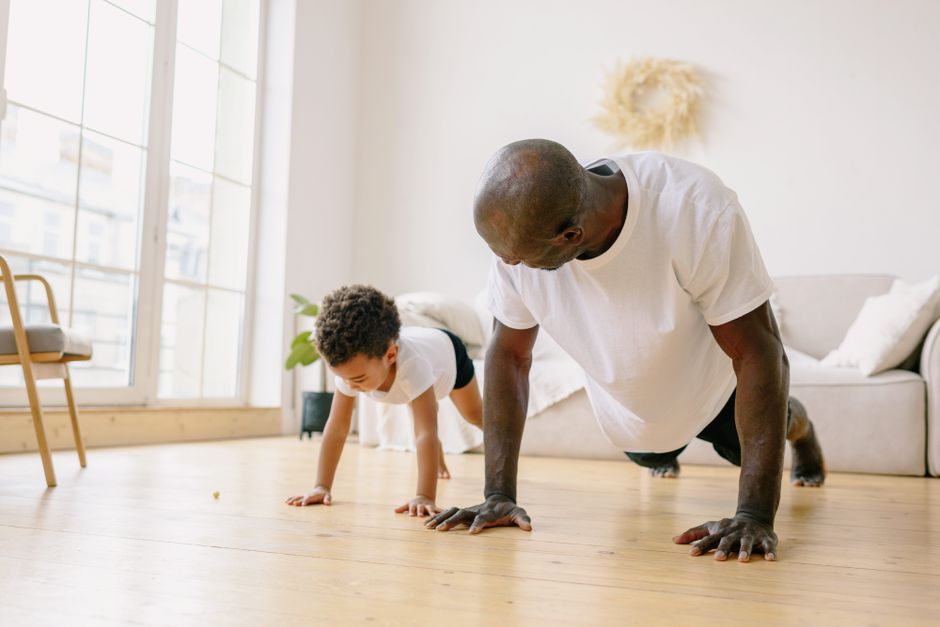
You want to be stronger. You also have a school pickup in 20 minutes, a sink full of dishes, and three notifications you haven’t answered. This is the reality most fitness advice ignores.
Strength training for busy parents at home does not require a dedicated gym space, a one-hour window, or a perfect mindset. Research published in the Journal of Strength and Conditioning Research suggests that shorter, higher-effort sessions using compound movements can produce meaningful strength gains comparable to longer workouts when volume is matched. The sessions below reflect that principle.
What follows are four real-life parent scenarios, each built around a 15-minute window and the actual conditions parents deal with every day.
Case 1: The Early Riser Who Only Has the Kitchen Floor
The situation: Maya, a mother of two under age five, wakes at 5:45 a.m. before anyone else stirs. She has no weights, no mat, and 15 minutes before the first child calls out.
Her routine:
- 10 slow bodyweight squats (3 seconds down, pause, 3 seconds up)
- 8 incline push-ups using the kitchen counter
- 10 glute bridges on the tile floor
- 30-second wall sit
- Repeat twice
Why it works: Slowing the tempo of a squat or push-up increases time under tension, which research from McMaster University suggests is a meaningful driver of muscle adaptation, even without added load. Maya does not track reps obsessively. She moves with intention and finishes before the house wakes up.
Her honest report: “I felt ridiculous at first doing squats in my kitchen. Now it’s the one thing I do for myself before the chaos starts.”
If you’re just starting out, the guide on Strength Training for Beginners at Home: Build Confidence and Lean Muscle Without Equipment or a Gym covers the core movement patterns Maya uses here.

Case 2: The Dad Who Trains During Nap Time
The situation: Derek is a stay-at-home father of a toddler. Nap time runs from 1:00 to 2:30 p.m., but he uses the first 90 minutes for actual rest or household tasks. The last 15 minutes are his.
His routine:
- 5 slow Romanian deadlifts with two full water jugs (improvised load)
- 8 bent-over rows with the same jugs
- 10 reverse lunges per side
- 10 overhead press with jugs
- Rest 60 seconds, repeat
Why it works: Compound, multi-joint movements like deadlifts and rows train multiple muscle groups simultaneously, making them especially efficient when time is limited. Derek’s water jugs hold roughly 8 to 10 pounds each, which is enough load to challenge a beginner or intermediate mover with good tempo.
The honest tradeoff: Some days he skips the second round entirely because the toddler wakes early. He finishes what he can and moves on without guilt.
For a broader look at equipment options as you progress, Resistance Bands vs. Dumbbells for Home Strength Training breaks down what’s actually worth buying on a tight budget.

Case 3: The Working Mom Who Trains After Bedtime
The situation: Priya works full time, gets home around 6:30 p.m., handles dinner and bedtime, and carves out 15 minutes near 9:00 p.m. She is often tired but consistently shows up three times a week.
Her routine:
- 8 push-ups (knees if needed)
- 10 sumo squats
- 8 single-leg glute bridges per side
- 15-second plank hold, build toward 30 seconds
- 10 tricep dips off a sturdy chair
- Repeat twice if energy allows
Why it works: Priya’s late-evening timing is not ideal for sleep if the session is high intensity, but a moderate-effort strength circuit does not spike adrenaline the way cardio or HIIT does. She follows her workout with a light snack containing both protein and a small amount of carbohydrate, which research suggests supports overnight muscle repair. For practical ideas on what to eat after training, see Strength Training Recovery Nutrition: What to Eat After Your Workout for Muscle Repair.
Her honest report: “I don’t always want to start. But I’ve never finished and felt worse. That’s what keeps me going back.”

Case 4: The Two-Parent Household Using Five-Minute Windows
The situation: James and Sofia have three school-age kids and opposite work schedules. A contiguous 15-minute block rarely exists for either of them. Instead, they stack three five-minute micro-sessions across the day.
Their approach:
- Morning (5 min): 10 push-ups, 10 squats, 10 hip hinges, repeat
- Midday (5 min): 10 walking lunges per side, 20-second wall sit, 8 single-arm rows with a backpack
- Evening (5 min): 10 glute bridges, 10 overhead press with resistance band, 15-second side plank per side
Why it works: The National Strength and Conditioning Association (NSCA) recognizes that training frequency and cumulative weekly volume matter more than session length. Distributed training is not inferior to a single block when total work is similar. James and Sofia are not training around their life; they have made training part of the texture of their life.
For more on integrating movement across a busy schedule, Building a Home Strength Routine as a Busy Parent: Real Workouts That Fit Into Family Life offers additional context.

What These Four Routines Have in Common
None of these parents train perfectly. All of them have skipped sessions, started late, and used less-than-ideal equipment. What they share is:
- Compound movements: Squats, hinges, rows, presses, and carries train the whole body efficiently.
- Consistent frequency over heroic effort: Three to four short sessions per week outperform one exhausting attempt to catch up.
- Adjustable intensity: Every exercise above has a simpler version (counter push-up, chair squat) and a harder one (tempo, single-leg, added load).
- No perfection required: Starting, adjusting, and finishing imperfectly still builds strength over time.
If you want to keep progressing beyond the beginner phase, Building a Sustainable Strength Training Routine at Home: Progressive Workouts From Bodyweight to Basic Equipment shows how to add challenge without overhauling your routine.

One Small Action Worth Taking Today
Choose one of the four routines above that most closely matches your actual schedule. Not the ideal version of your schedule. The real one. Try it twice this week without judging the quality. Consistency built on realistic expectations will take you further than ambitious plans that collapse under pressure.
For practical weekly guidance on nutrition, movement, and whole-person habits, the Clean Body Mentor newsletter is one easy way to stay connected to ideas that fit real life.
This article is for general educational and informational purposes only and is not a substitute for medical advice, diagnosis, or treatment. Health needs vary by individual. Consult a qualified healthcare professional before making significant changes to your diet, exercise routine, supplements, medication, or treatment plan, especially if you have a medical condition, are pregnant or breastfeeding, take medication, or have concerns about your symptoms.
Sources
- Schoenfeld, B.J., et al. “Effects of Resistance Training Frequency on Measures of Muscle Hypertrophy.” Journal of Strength and Conditioning Research, 2016. (National Strength and Conditioning Association publication)
- Burd, N.A., et al. “Muscle time under tension during resistance exercise stimulates differential muscle protein sub-fractional synthetic responses in men.” Journal of Physiology, 2012. McMaster University.
- National Strength and Conditioning Association (NSCA). Essentials of Strength Training and Conditioning, 4th edition.