


You lace up your shoes, commit to walking every day, and feel genuinely motivated for about two weeks. Then life gets busy, your knees feel tired, or the same loop around the block stops feeling worth it. Sound familiar?
The problem rarely comes down to willpower. Most people abandon a new walking habit because they start too ambitiously, measure success by distance instead of consistency, or never find routes and times that actually fit their real life.
This tutorial walks you through a practical approach to building a walking habit that compounds over time without burning you out in the first month.

Why Consistency Beats Intensity When You Are Just Starting
Research published by the U.S. Department of Health and Human Services in the Physical Activity Guidelines for Americans is clear: regular moderate physical activity, including walking, offers significant health benefits. But the guidelines also acknowledge that some activity is better than none, and building a sustainable habit matters more than hitting a daily step count right away.
When you prioritize showing up over performing, you lower the psychological barrier to each session. A 10-minute walk that you actually complete beats a 45-minute route you skip because it feels like too much. Consistency is what builds the neural habit loop, not duration.
If you are coming back to movement after a long break, or managing stiffness from a desk-heavy lifestyle, pairing a gentle walking plan with a few minutes of stretching can make each outing more comfortable. Mobility Routines for Office Workers: Reverse Sitting Stiffness and Build Movement Confidence in 10 Minutes Daily is a useful companion resource for loosening up before you head out.

Week-by-Week Progression: From 10 Minutes to a Daily Practice
The framework below is a rough guide, not a rigid prescription. Adjust based on how your body feels.
Weeks 1 and 2: Anchor the habit
- Walk for 10 to 15 minutes, 4 to 5 days per week.
- Pick a time that works with your existing schedule, right after your morning coffee, during a lunch break, or after dinner.
- Focus entirely on showing up. Pace and distance are irrelevant right now.
- Keep the same route so decisions are minimized.
Weeks 3 and 4: Add small increments
- Extend each walk by 5 minutes.
- Start experimenting with a second route so the habit stays interesting.
- Notice how your energy and mood shift after walks. This awareness reinforces motivation naturally.
Weeks 5 through 8: Build variety and mild challenge
- Aim for 25 to 35 minutes per session, still at a comfortable conversational pace.
- Introduce one slightly hilly or varied-terrain walk per week if your joints allow it.
- If you miss a day, pick back up the following day without guilt. A one-day gap does not break a habit.
Beyond 8 weeks: Sustainable daily movement
- Walking has likely become part of your identity by now, not just a task on a list.
- You can increase frequency, duration, or terrain based on personal goals.
- For readers with weight management goals, Walking for Weight Loss: A Realistic Approach to Fat Loss Through Daily Movement covers how to structure sessions for body composition benefits without overdoing it.
Choosing Environments That Make You Want to Come Back
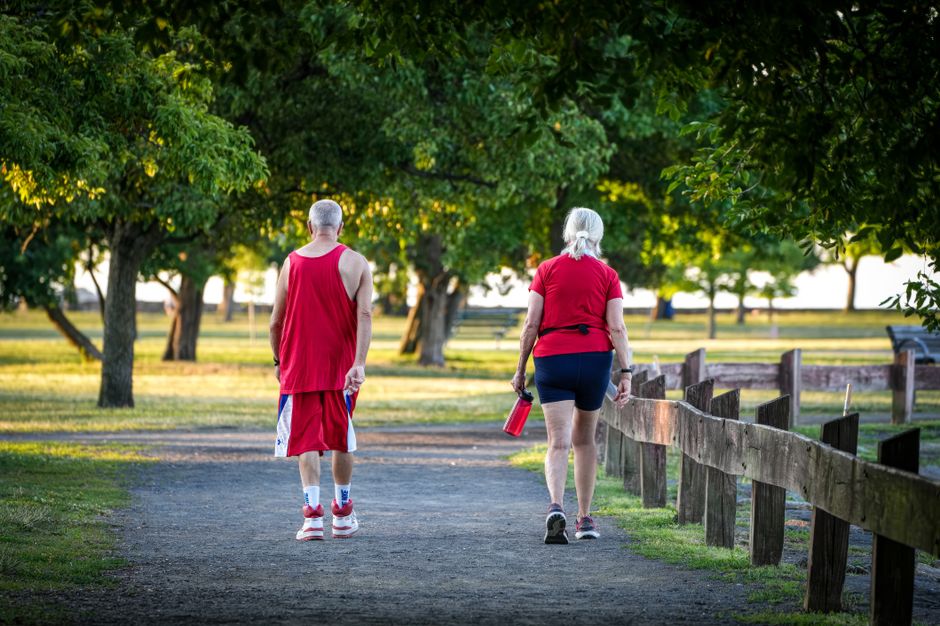
One underrated driver of a lasting walking habit is the environment you choose. The same pavement loop repeated daily becomes a chore. Novelty and sensory interest, whether that is a tree-lined path, a lake view, or a neighborhood you have not explored, genuinely help sustain motivation.
Research suggests that walking in natural or green environments may offer additional mood benefits compared to urban or indoor settings. A review cited by the University of Exeter found that outdoor nature exposure was associated with lower stress and improved well-being. The science does not require a forest, a quiet street with mature trees or a local park can offer similar benefits.
Practical ideas for keeping your environment interesting:
- Rotate between two or three familiar routes during the week.
- Drive to a different neighborhood or trail once a week as a small adventure.
- Walk with a podcast, audiobook, or playlist reserved only for walking (this creates a reward your brain anticipates).
- Invite a friend or family member occasionally. Social accountability nudges you out the door on low-motivation days.
For more on how the outdoor element specifically supports your mental state, Outdoor Movement as Mental Medicine: Walking, Gardening, and Unstructured Activity for Stress and Mood goes deeper into the mind-body connection.

Recognizing and Preventing the Two Most Common Burnout Patterns
Pattern 1: Doing too much too soon
Adding 20 or 30 minutes overnight is a common enthusiasm mistake. Your cardiovascular system adapts quickly, but your tendons, ligaments, and joints need more time. The widely used “10 percent rule” in running and walking communities suggests increasing your weekly walking time by no more than 10 percent each week to reduce overuse injury risk. If something starts aching, scale back rather than pushing through.
Pattern 2: Tying success to a number
Fixing your identity around hitting 10,000 steps daily can backfire when life interrupts your streak. Research from institutions including Brigham and Women’s Hospital (Harvard) has shown that meaningful health benefits occur at step counts well below 10,000, with notable improvements appearing around 7,000 to 8,000 steps for many adults. Aim for a personalized, realistic number rather than a culturally popular one.

Making Walking Work With the Rest of Your Day
A walking habit does not need its own dedicated time slot, though that helps. You can accumulate movement across the day in smaller pieces:
- Park further from an entrance and walk the difference.
- Take calls on foot when possible.
- Use a walking break as a genuine focus reset in the middle of your workday.
- A short evening walk after dinner may support digestion and help your body wind down before sleep.
For readers who eventually want to complement walking with additional strength and mobility work, Building a Sustainable Walking Plan for Fat Loss and Fitness Confidence outlines how to layer in other movement without overcomplicating your routine.

One Step at a Time
The most sustainable walking habit is the one you can repeat tomorrow, next week, and in three months. Start with what feels almost too easy, protect that routine until it becomes automatic, and let the improvements come from there.
Choose one small action from this guide and commit to it this week, whether that is a 10-minute walk after dinner tonight, scouting a new route, or simply setting a consistent time in your calendar. Small, repeated actions build real habits over time.
For more practical movement and wellness guidance delivered weekly, consider joining the Clean Body Mentor newsletter.
This article is for general educational and informational purposes only and is not a substitute for medical advice, diagnosis, or treatment. Health needs vary by individual. Consult a qualified healthcare professional before making significant changes to your diet, exercise routine, supplements, medication, or treatment plan, especially if you have a medical condition, are pregnant or breastfeeding, take medication, or have concerns about your symptoms.

Sources
- U.S. Department of Health and Human Services. Physical Activity Guidelines for Americans, 2nd Edition. health.gov/paguidelines/second-edition/
- University of Exeter. Green space, nature, and well-being research. exeter.ac.uk
- Brigham and Women’s Hospital, Harvard Medical School. Research on step count and health outcomes. brighamandwomens.org
- Lee I-Min et al. “Association of Step Volume and Intensity with All-Cause Mortality in Older Women.” JAMA Internal Medicine, 2019. (PubMed)