


Your body is not the same at 7 a.m. as it is at 2 p.m. or 9 p.m. Muscle temperature changes through the day, your nervous system shifts between high alert and recovery mode, and your posture takes on different kinds of stress depending on what you have been doing for the past few hours. That means a single one-size-fits-all stretching routine may be leaving a lot of benefit on the table.
This guide breaks down three distinct stretching routines, one for each key window of your day. You will learn which movements fit each time, why the timing matters from a physiological standpoint, and how to weave all three into a realistic daily schedule, even on busy days. Whether you are a beginner, a desk worker, a parent fitting movement into the margins of family life, or someone rebuilding the habit of moving more, these stretching routines are designed to meet you where you are.

Why Timing Your Stretching Routine Actually Matters
Timing is not just a scheduling preference. Research suggests that muscle temperature, cortisol patterns, and nervous system state all influence how your tissues respond to stretching and what kind of movement will feel supportive rather than stressful.
In the morning, core body temperature is near its lowest point and muscle tissue is stiffer from hours of relative stillness. Aggressive stretching on cold, stiff muscles can feel uncomfortable and may even contribute to minor strains if you push too hard too soon. The goal in the morning is gradual, gentle movement that slowly increases circulation and range of motion without shocking the system.
Midday brings a different set of challenges. After several hours of sitting, standing, or repetitive movement, certain muscle groups become shortened and tight, particularly the hip flexors, chest, and upper back. This is when dynamic movement, which involves controlled motion through a range rather than static holds, can restore circulation, relieve postural tension, and give your energy a natural lift without caffeine.
By evening, your core body temperature has begun to drop again and your nervous system is (ideally) transitioning toward parasympathetic, or rest-and-digest, mode. Long, slow, static holds and breathing-focused stretches align well with this biology and may help prepare both your body and mind for quality sleep.
Understanding this rhythm helps you choose the right tool for the right moment, which is the foundation of sustainable habits that actually stick.

Morning Stretching Routine: Gentle Wake-Up Mobility (10-15 Minutes)
The purpose of a morning stretching routine is not to maximize flexibility. It is to ease stiffness, wake up your joints gradually, and set a calm but energized tone for the day. Think of it as a slow transition from sleep mode to active mode.
Key Principles for Morning Stretching
- Move slowly and breathe deeply through each position
- Avoid pushing into sharp discomfort, especially in the first few minutes
- Focus on large muscle groups first, then progressively smaller ones
- Aim for 30 to 45 seconds per position rather than deep, forced stretching
Morning Routine: Step by Step
1. Supine Knee-to-Chest (Lying Down, 1-2 Minutes)
Before you even get out of bed, lie on your back and draw one knee gently toward your chest, holding it lightly with both hands. Hold for 30 seconds, then switch sides. This releases overnight tension in the lower back and hip flexors without demanding anything from cold muscles.
2. Cat-Cow (Floor, 2 Minutes)
Move to all fours on a mat or carpet. Inhale as you drop your belly and lift your chest (cow), then exhale as you round your back toward the ceiling (cat). Repeat this slowly for 8 to 10 breath cycles. This movement gently mobilizes the entire spine and is especially helpful if you wake up with a stiff lower or mid back.
3. Child’s Pose with Side Reach (Floor, 2 Minutes)
From all fours, sit your hips back toward your heels, reaching your arms long in front of you. Hold for 30 to 40 seconds, then walk your hands to the right to open up the left side of your back and lat, hold, then repeat on the left. This stretch targets the thoracic spine and side body, areas that often feel compressed overnight.
4. Standing Hip Circles (Standing, 1 Minute)
Stand with feet hip-width apart, hands on your hips, and slowly rotate your hips in large circles, 5 to 6 rotations in each direction. This gently lubricates the hip joints and brings circulation into the lower body.
5. Doorway Chest Opener (Standing, 1-2 Minutes)
Place your forearms on either side of a doorframe and gently lean forward until you feel a light stretch across the chest and front of the shoulders. Hold for 20 to 30 seconds, rest, and repeat twice. For many people who sleep on their side, chest muscles tighten overnight and this gentle opener helps reverse that pattern.
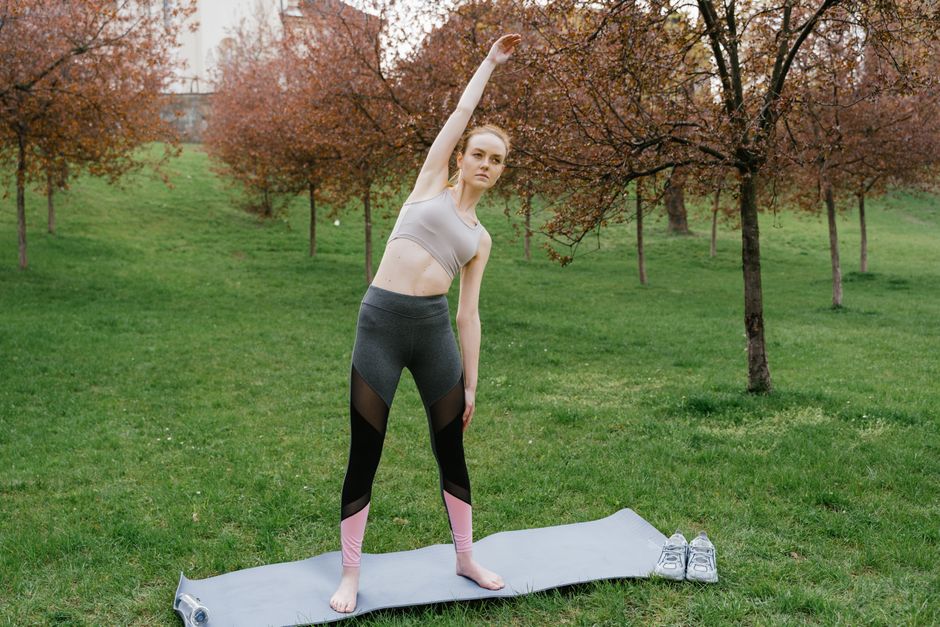
6. Gentle Standing Side Stretch (Standing, 1-2 Minutes)
Raise one arm overhead and lean gently to the opposite side, holding for 20 to 30 seconds per side. This wakes up the intercostal muscles between the ribs and helps deepen your breathing as you head into the day.
If you are also working to improve your sitting posture or counteract desk work, the guide on Stretching and Mobility Routines for Desk Workers: Counteract Sitting and Improve Daily Movement pairs well with this morning sequence.

Midday Stretching Routine: Dynamic Reset for Energy and Posture (8-12 Minutes)
By midday, most people have been sitting, commuting, standing, or repeating the same physical pattern for three to five hours. This creates predictable tension spots: tight hip flexors from sitting, compressed thoracic spine from slumping, and shortened chest muscles from leaning toward a screen. A midday stretching routine targets these areas with dynamic movement, meaning controlled motion through a range rather than held static positions.
Dynamic stretching is generally more appropriate mid-activity because it raises muscle temperature slightly, encourages blood flow, and can provide a noticeable energy lift, all without requiring you to lie on a mat in your office.
Key Principles for Midday Stretching
- Move through ranges of motion rather than holding long static positions
- Keep the pace moderate, neither rushed nor slow enough to feel like a nap
- Focus on reversing the postures you have held all morning
- Even five minutes in a hallway, bathroom, or outside is worthwhile
Midday Routine: Step by Step
1. Neck Rolls (Standing or Seated, 1 Minute)
Drop your chin toward your chest and slowly roll your head from one shoulder to the other, avoiding rolling back over the cervical spine. Perform 5 to 6 slow, controlled passes. This releases tension in the upper trapezius and neck muscles that accumulate from screen time.
2. Thoracic Extension Over Chair Back (Seated, 1-2 Minutes)
Sit upright in a firm chair and place your hands behind your head. Gently arch backward over the top of the chair back, aiming to extend the upper and mid back rather than the lower back. Hold for 10 to 15 seconds, return upright, and repeat 4 to 5 times. This directly counteracts the forward flexion posture that most desk workers spend hours in.
3. Standing Hip Flexor Lunge Stretch with Rotation (Standing, 2-3 Minutes)
Step one foot forward into a lunge position, drop the back knee toward the floor if possible, and shift your hips forward gently until you feel a stretch at the front of the back hip. Add a gentle torso rotation toward your front knee for an added spinal mobility benefit. Hold 20 to 30 seconds per side, move in and out of the position a few times rather than holding completely still.
4. Wall Shoulder Circles (Standing, 1-2 Minutes)
Stand an arm’s length from a wall, place your palm flat against it at shoulder height, and slowly move your arm in circles on the wall surface, spiraling outward from small to large. Repeat in the reverse direction. This releases tension in the rotator cuff and posterior shoulder that accumulates from mouse use and keyboard position.
5. Standing Figure-Four Hip Opener (Standing, 2 Minutes)
Stand near a wall for balance. Cross your right ankle over your left knee, then gently bend your standing leg until you feel a stretch in the right glute and outer hip. Hold 20 to 30 seconds, then switch sides. This movement targets the piriformis and external hip rotators that become compressed during long periods of sitting.
Pairing this midday movement reset with a nutrient-dense lunch can amplify your afternoon energy. The article on Eating for Stable Energy: Nutrient Combinations That Keep You Full and Focused All Day explains which food combinations help sustain focus between meals.

Evening Stretching Routine: Calming Wind-Down for Better Sleep (12-15 Minutes)
Evening stretching routines have a different goal than morning or midday sessions. Rather than energizing, the aim is to downregulate. Long, slow holds combined with deliberate breathing activate the parasympathetic nervous system and help signal to the body that it is time to shift toward rest. Research suggests that relaxation-focused stretching before bed may support sleep quality, particularly for people who carry physical tension from the day.
This is not the time for aggressive mobility work or anything that raises heart rate significantly. Soft surfaces, dim lighting, and quiet breathing are the right environment for this routine.
Key Principles for Evening Stretching
- Use long, slow static holds of 45 to 90 seconds or more
- Breathe in through the nose and out through the mouth with a slightly extended exhale
- Let gravity do the work rather than forcing depth
- Perform this routine within one to two hours before bed for the best effect
Evening Routine: Step by Step
1. Legs-Up-the-Wall Pose (Floor, 3-5 Minutes)
Sit sideways next to a wall, then swing your legs up so they rest vertically against it while your back lies flat on the floor. Let your arms rest at your sides, palms up. Breathe slowly. This passive inversion encourages venous return from the legs, relieves compression in the lower back, and is deeply calming for the nervous system. It is one of the most underrated tools in any evening stretching routine.
2. Supine Spinal Twist (Floor, 2-3 Minutes)
Lie on your back with knees bent. Let both knees fall slowly to one side while your arms open wide and your gaze goes the other direction. Stay here for 45 to 90 seconds, breathe slowly, then switch sides. This releases the erector spinae, lower back, and outer hips with almost no effort required.
3. Seated Forward Fold (Floor or Chair, 2 Minutes)
Sit with legs extended straight in front of you (or seated at the edge of a chair with legs together). Hinge at the hips, reaching your hands forward along your legs as far as is comfortable without rounding aggressively. Let your head drop and hold for 60 to 90 seconds. This targets the hamstrings, lower back, and calves, muscles that often remain contracted from walking, standing, or driving.
4. Butterfly Stretch (Floor, 2 Minutes)
Sit with the soles of your feet together, letting your knees drop outward. Hold your feet and gently hinge forward at the hips, keeping your back relatively long. Hold for 60 seconds. This opens the inner thighs and groin, areas that may carry tension from both sitting and physical activity.
5. Supported Chest Opener on Bolster or Rolled Blanket (Floor, 2-3 Minutes)
Roll a blanket or use a pillow to create a gentle support. Lie over it so that it runs vertically along your spine and your arms fall open to the sides. Let your chest open passively, breathe slowly, and hold for 2 to 3 minutes. This counteracts the forward shoulder posture of the day and is a gentle way to close the stretching session.
If you are curious about how recovery and rest fit into your overall movement practice, the guide on Recovery Days and Active Rest: Why Your Body Needs Breaks as Much as It Needs Workouts offers a helpful perspective on balancing effort and restoration.
Common Mistakes to Avoid in Your Stretching Routines
Even with good intentions, a few patterns tend to reduce the effectiveness of stretching routines or create unnecessary discomfort.
Bouncing instead of holding: Ballistic stretching, which involves quick bouncing movements, is not appropriate for any of these three routines. It activates the stretch reflex and may increase the risk of minor muscle strains, particularly in cold muscles.
Skipping breath: Many people hold their breath when stretching, which increases muscle tension and reduces the benefit. Breathing fully throughout each stretch, especially with a slow exhale, helps the tissue release more effectively.
Treating morning stretching like a warm-up for intense exercise: If you plan to run, do strength training, or perform vigorous activity in the morning, a light dynamic warm-up specific to that activity is more appropriate than the gentle mobility sequence above. The morning routine in this guide is designed for general daily function, not athletic preparation.
Comparing your range of motion to others: Flexibility varies significantly by genetics, age, activity history, and joint structure. Pushing to match someone else’s range is not only unnecessary, it can contribute to injury. Your baseline is your baseline, and gradual progress is both realistic and enough.
Doing it only when you are already in pain: Stretching routines work best as consistent daily habits rather than emergency interventions. If you are already experiencing significant tightness or pain, that is a signal to be extra gentle, not more aggressive.
For readers who are also building a broader movement practice, Building a Sustainable Strength Training Routine at Home: Progressive Workouts From Bodyweight to Basic Equipment is a practical complement to these stretching protocols.

How to Build These Three Routines Into a Realistic Day
The biggest barrier to consistent stretching is not motivation; it is not having a clear plan for when exactly it happens. Here is a practical framework.
- Morning (10-15 minutes): Do this before your first coffee if possible, or directly after getting out of bed. Keep a mat near your bedside or on the floor of your bedroom to reduce friction.
- Midday (8-12 minutes): Anchor this to lunch. Stretch before you eat, during a break, or immediately after a meal if you feel comfortable doing so. Some people find that a short movement break after eating helps with digestion and energy.
- Evening (12-15 minutes): Treat this as the beginning of your wind-down routine rather than an afterthought. Pair it with dimming lights, putting your phone down, or brewing herbal tea to reinforce the signal that it is time to rest.
If all three sessions feel overwhelming to start, pick one. The morning and evening routines tend to deliver the most perceived benefit for most people, so those are natural starting points.
Building any new habit takes time, and it can help to read about how others have made similar shifts. How Three Readers Built Sustainable Healthy Habits Without Perfectionism: Real Stories and Honest Lessons offers honest, realistic perspectives on starting small and staying consistent.

Safety Notes and When to Consult a Professional
These stretching routines are designed for generally healthy adults without active injuries. If you have any of the following, speak with a qualified healthcare professional or physiotherapist before starting or modifying a stretching routine:
- Recent or chronic joint pain, instability, or injury
- A diagnosed musculoskeletal condition such as hypermobility disorders, herniated discs, or osteoporosis
- Pregnancy (the supine positions in particular may need modification after the first trimester)
- Post-surgical recovery
- Neurological symptoms such as numbness, tingling, or radiating pain during stretching
A light stretch that makes you feel a gentle pulling sensation is appropriate. Pain, sharp sensations, or numbness are signals to ease off immediately and, if persistent, seek professional evaluation.

Frequently Asked Questions About Stretching Routines
How long should each stretching routine take to see results?
Consistency matters more than duration. Research suggests that performing stretching routines at least four to five days per week over four to eight weeks produces meaningful improvements in range of motion and flexibility. Even short sessions of 10 minutes add up over time.
Is it okay to stretch every day?
For the types of stretching in this guide, yes. Gentle mobility work and static stretching at low to moderate intensity are generally safe for daily practice. Listen to your body and take a rest day if you feel unusual soreness or fatigue.
Should I stretch before or after a workout?
The routines in this article are not designed as pre-workout or post-workout sessions specifically. As a general guideline, dynamic movements pair well before activity to warm up the joints, while static holds are better suited to post-workout cool-downs when muscles are already warm. For a dedicated workout stretching strategy, consult a certified fitness professional.
Can stretching help with lower back pain?
For many people, regular gentle stretching may help reduce everyday lower back tension and stiffness. However, back pain has many causes, and some conditions are made worse by certain stretches. If you have persistent or significant lower back pain, a physiotherapist or qualified healthcare professional can help identify which movements are appropriate for your situation.
What if I am too stiff to do some of these stretches?
All of these routines can be modified. Use props like pillows, folded blankets, a wall, or a chair for support. Reduce your range of motion to whatever is comfortable. Stiffness itself is often why stretching feels difficult at first, but with consistent, gentle practice over several weeks, most people notice meaningful improvement.
This article is for general educational and informational purposes only and is not a substitute for medical advice, diagnosis, or treatment. Health needs vary by individual. Consult a qualified healthcare professional before making significant changes to your diet, exercise routine, supplements, medication, or treatment plan, especially if you have a medical condition, are pregnant or breastfeeding, take medication, or have concerns about your symptoms.

Your Next Step
Choose one of the three routines in this guide and commit to trying it for the next five days. If mornings feel chaotic, start with the evening wind-down. If afternoons are your low-energy window, try the midday reset first. Even a single ten-minute session done consistently will teach your body that this is now part of the routine.
When you are ready to expand your movement practice further, the Building a Sustainable Walking Plan for Fat Loss and Fitness Confidence guide is a simple, low-barrier next step. And if you want more practical weekly wellness guidance delivered to you, consider joining the Clean Body Mentor newsletter for ideas you can actually use.