
If the idea of an hour-long gym session sounds impossible right now, you are not alone. Between work, family, and the thousand other things competing for your time, a full workout can feel like a luxury you simply cannot afford. The good news is that short home strength training for beginners works, and research supports it.
A 2019 study published in Medicine and Science in Sports and Exercise found that even a single set of resistance exercises performed to fatigue produced meaningful strength gains, comparable to multiple sets for beginners. Translation: your 20 minutes matter more than you think, especially when you are just starting out.
This four-week plan is built around three sessions per week, each capped at 20 minutes. You need no gym, no barbell, and no prior experience. A resistance band (roughly $10 to $15 online) is optional but useful. Everything else is your bodyweight and a clear progression framework.
Before diving in, it helps to understand one important principle: consistency beats intensity at every stage of early training. Showing up three times a week for a month does more for your body than one heroic workout followed by two weeks of soreness and avoidance. Keep that in mind as you read through each week.

Why 20 Minutes Is Enough (When You Use It Well)
The key is exercise selection. Instead of spreading your time across ten exercises, you focus on compound movements that work multiple muscle groups at once. Squats, hinges, pushes, and pulls are the four movement patterns that cover almost every major muscle in the body.
For beginners, the nervous system adapts quickly in the first four to eight weeks of training. This is sometimes called neural adaptation, and it means your strength can improve noticeably before your muscles visibly change size. You are essentially teaching your body to coordinate and recruit the muscle fibers it already has. That process does not require volume, it requires consistency and progressive challenge.
If you are curious about how bodyweight progression compares to lifting heavier weights, Building Intuitive Strength at Home: Why Bodyweight Progression Works Better Than Heavy Weights for Beginners offers a helpful framework for understanding the early stages of strength development.

Your Four-Week Progressive Plan
Each session follows the same structure: 2 minutes of gentle warm-up movement (leg swings, arm circles, hip circles), then three to four exercises for 15 to 20 minutes, then a brief cool-down stretch.
Rest 45 to 60 seconds between sets. Move at a controlled pace, counting two seconds down and one second up on every rep.
Week 1: Building the Foundation
Session A (repeat twice this week)
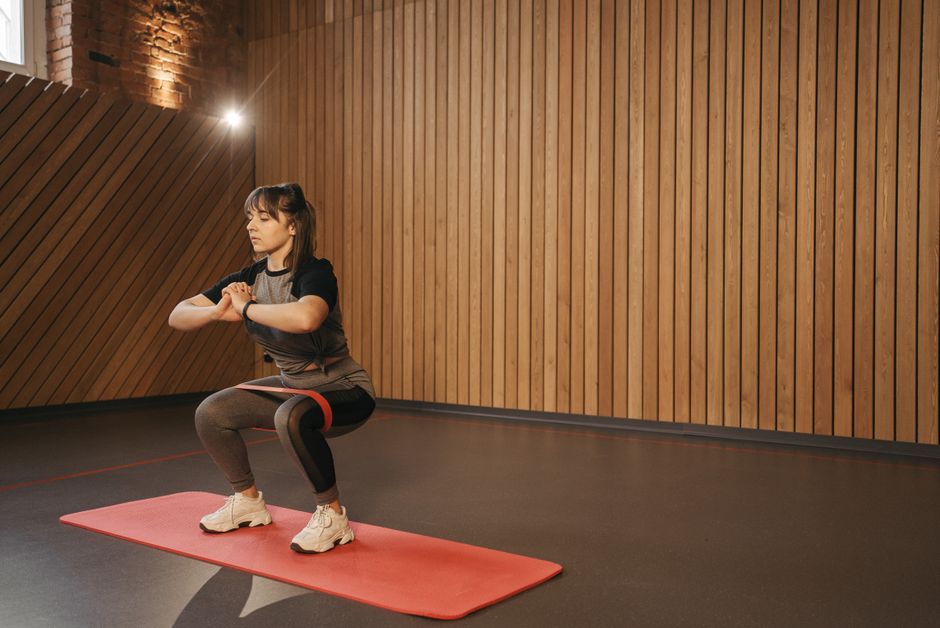
- Bodyweight squat: 2 sets of 10 reps
- Wall push-up or knee push-up: 2 sets of 8 reps
- Glute bridge: 2 sets of 10 reps
- Dead bug (core): 2 sets of 6 reps per side
Session B (once this week)
- Reverse lunge: 2 sets of 8 reps per leg
- Resistance band row (or prone Y raise): 2 sets of 10 reps
- Plank hold: 2 sets of 15 to 20 seconds
Focus on form over speed. If a wall push-up feels too easy by day three, move to an incline push-up with hands on a counter or sturdy chair.
Week 2: Adding Reps and Time Under Tension
Repeat the same exercises but increase to 3 sets per exercise and add 2 to 4 reps where the previous week felt manageable. Slow your tempo on the way down to a three-count.
- Bodyweight squat: 3 sets of 12
- Incline or knee push-up: 3 sets of 10
- Glute bridge (add a 2-second hold at the top): 3 sets of 12
- Reverse lunge: 3 sets of 10 per leg
- Band row: 3 sets of 12
- Plank: 3 sets of 25 seconds
Week 3: Progressing the Movements
This week, you upgrade one or two exercises to a harder variation.
- Goblet squat (hold a water bottle or light backpack for load): 3 sets of 10
- Full floor push-up (or incline if needed): 3 sets of 8 to 10
- Single-leg glute bridge: 3 sets of 10 per leg
- Reverse lunge with a forward lean for more glute emphasis: 3 sets of 10 per leg
- Band row with a 1-second squeeze at the peak: 3 sets of 12
- Plank to shoulder tap: 3 sets of 8 per side
If a new variation feels shaky, drop back one level for that exercise only. Progress is not linear, and scaling is a skill, not a setback. A deeper look at common reasons progress stalls is covered in Strength Training Plateaus: Five Beginner Mistakes That Stall Progress and How to Break Through Them.
Week 4: Consolidation and Challenge
Week four is about cementing what you have built and testing yourself slightly.
- Goblet squat: 3 sets of 12 to 14
- Full push-up (aim for 3 sets of 10): scale as needed
- Romanian deadlift with a resistance band or loaded backpack: 3 sets of 10
- Lateral band walk (or bodyweight side lunge): 3 sets of 12 per side
- Band row: 3 sets of 14
- Dead bug: 3 sets of 8 per side
By the end of week four, you will likely notice improved stability, a bit more ease in daily movements like carrying groceries or climbing stairs, and a stronger sense of what your body can do.
Recovery, Soreness, and Rest Days
Some muscle soreness in the first two weeks is normal, especially 24 to 48 hours after a session. This is called delayed onset muscle soreness (DOMS), and it signals that your muscles are adapting. What is not normal is sharp, joint-level pain or pain that does not fade within 72 hours.
For a clear guide on telling the difference, Strength Training Soreness vs. Injury Pain: How to Tell the Difference and Know When to Rest or Push Through is worth bookmarking before you start.
On rest days, light movement helps more than the couch. A short walk, gentle stretching, or a few mobility exercises supports recovery without adding training stress. Strength Training Recovery Days: Why Active Stretching Beats Complete Rest for Muscle Growth explains why this works and gives you a practical routine.

Staying Consistent When Motivation Dips
Motivation is unreliable. What keeps a short home strength training habit alive past the first two weeks is structure and low friction. Schedule your three sessions the same way you would a meeting. Keep your resistance band and a water bottle in a visible spot. Lower the activation cost of starting.
If you miss a session, pick up the next one without adjusting or punishing yourself. One missed workout changes nothing over a month. Three weeks of sporadic effort changes everything. Gradual progress and sustainable habits always outperform perfection.
Pick one exercise from Week 1 today, set a timer for 20 minutes, and complete your first session. That single action matters more than any plan you do not start. When you are ready for more structured movement in your week, explore the Walking for Stress Relief and Mood: A Three-Week Progressive Plan for Beginners as a low-impact complement to your strength days.
Disclaimer: This article is for general educational and informational purposes only and is not a substitute for medical advice, diagnosis, or treatment. Health needs vary by individual. Consult a qualified healthcare professional before making significant changes to your diet, exercise routine, supplements, medication, or treatment plan, especially if you have a medical condition, are pregnant or breastfeeding, take medication, or have concerns about your symptoms.

Sources
- Ralston, G.W., et al. “The Effect of Weekly Set Volume on Strength Gain: A Meta-Analysis.” Sports Medicine, 2017. (National Institutes of Health, PubMed)
- Schoenfeld, B.J., et al. “Resistance Training Volume Enhances Muscle Hypertrophy but Not Strength in Trained Men.” Medicine and Science in Sports and Exercise, 2019. (PubMed)
- American College of Sports Medicine. “ACSM’s Guidelines for Exercise Testing and Prescription,” 11th ed. Resistance training recommendations for beginners.
- National Institute on Aging (NIA). “Go4Life: Strength and Balance Exercises.” U.S. Department of Health and Human Services.