If your feet ache after a short walk, your ankles feel wobbly on uneven ground, or you notice a dull fatigue in your lower legs by midday, prolonged sitting may be quietly eroding the strength that keeps you moving well. Most people think of foot pain as a shoe problem or an age problem. Research suggests it is often a use problem.
The small intrinsic muscles of the foot, the ones responsible for arch support, toe grip, and push-off during walking, weaken without regular load. A 2019 systematic review published in the Journal of Orthopaedic and Sports Physical Therapy found that intrinsic foot muscle weakness is closely linked to arch collapse and poor lower-limb biomechanics. When those muscles go quiet from hours of sitting, even a short walking commute can feel more taxing than it should.
The good news: you do not need to leave your desk or buy any equipment. Three progressive foot strength exercises at your desk, done consistently, can begin to rebuild the foundation your walking depends on.
Why Sitting Erodes Foot Strength Faster Than You Expect
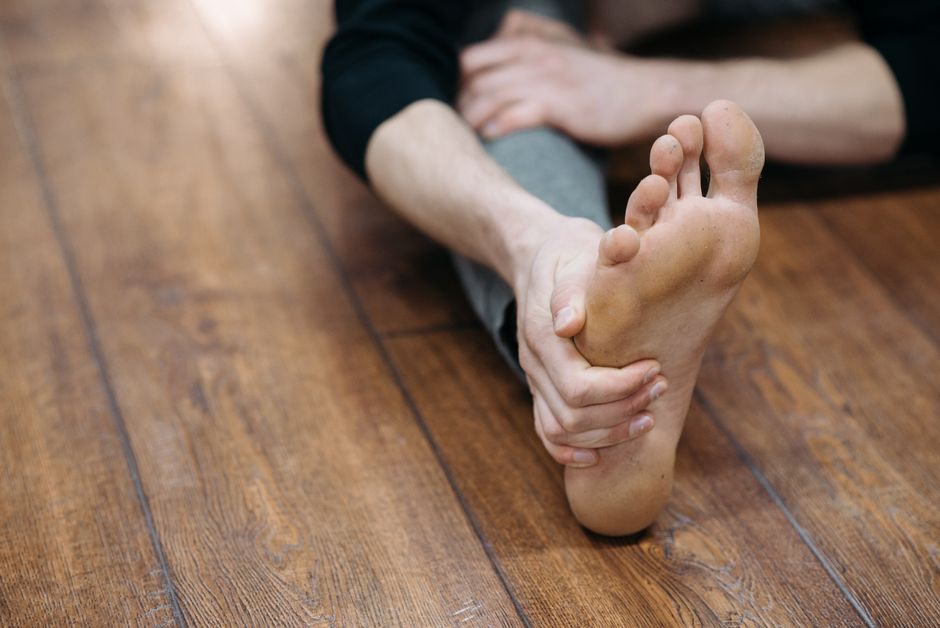
When you sit for long stretches, your feet rest flat on the floor in a passive, unsupported position. The arch is not required to work. The toes are not gripping or spreading. The ankle stabilizers are not firing because there is nothing to stabilize against.
Over months and years, this contributes to a predictable pattern: weakened plantar intrinsic muscles, reduced toe flexor strength, and a gait that compensates by overloading the heel and reducing push-off power. That compensation pattern can ripple upward into the knees, hips, and lower back.
If you are already working on hip or lower body movement quality, you may find that restoring foot function completes the picture. Home Leg Strength Without Equipment: Progressive Bodyweight Drills That Build Power for Stairs, Walking, and Daily Life is a good companion guide for building the full lower-body chain once your feet are ready to load it.
The Three-Level Progression
These drills move from seated (no weight) to standing (partial load) to single-leg (full functional load). Start at Level 1 even if you consider yourself active. The intrinsic foot muscles are a different category from the larger leg muscles you may already train.
Level 1: Seated Short-Foot and Toe-Spread Drills
Short-foot exercise: Sit upright with both feet flat on the floor, hip-width apart. Without curling your toes, try to shorten the length of your foot by drawing the ball of your foot toward your heel. You should feel a gentle doming of the arch. Hold for five seconds, release fully, and repeat eight to ten times per foot.
This drill targets the abductor hallucis and flexor digitorum brevis, two muscles that are almost entirely inactive during sitting. It may feel awkward at first because most people have limited neuromuscular control here. That unfamiliarity is exactly why it matters.
Toe spread and lift: Keep your heel planted. Spread all five toes as wide as possible, hold for three seconds, then lift just the big toe while keeping the other four down. Alternate: press the big toe down and lift the other four. Do eight repetitions per foot. This isolates the intrinsic toe muscles and trains the independent motor control your foot uses during the stance phase of walking.
Practice both Level 1 drills two to three times during your workday. They take under three minutes total and can be done invisibly during calls.
Level 2: Standing Heel Raises with Arch Awareness
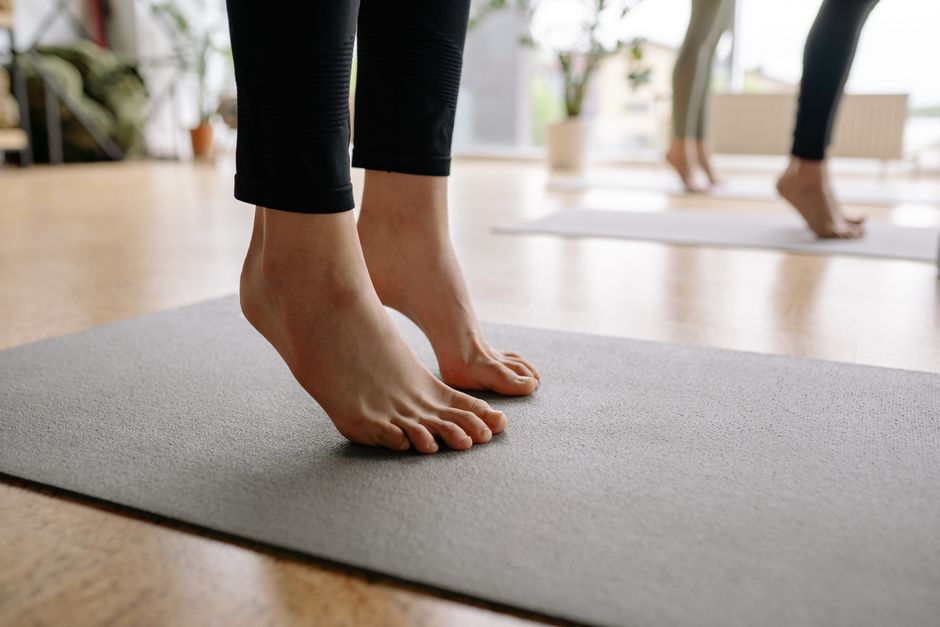
Stand behind your chair with fingertips resting on the back for light balance support. Before rising onto your toes, actively engage the short-foot position from Level 1: dome the arch slightly and spread the toes.
Rise slowly onto the balls of both feet over a count of three, hold at the top for two seconds, and lower over a count of three. Do three sets of ten. Once this feels controlled, progress to a single-leg heel raise: one foot stays flat while the other does the work.
The key cue is to push through the base of the big toe rather than rolling to the pinky side. Rolling outward is a compensation that bypasses the very muscles you are training.
For more context on how desk-bound posture compounds these movement patterns from foot to shoulder, Stretching for Desk Posture: Five Moves That Reverse Rounded Shoulders in 10 Minutes covers the upper-body side of the same problem.
Level 3: Single-Leg Stance with Progressive Challenge
This level begins to replicate the demands of real walking, where your entire body weight passes through one foot at a time.
Static hold: Stand on one foot, maintaining the domed arch and spread toes from Level 1. Hold for 20 to 30 seconds. Once you can do this with steady balance and minimal sway, move to the next challenge.
Dynamic reach: While balancing on one foot, slowly reach the opposite heel forward and tap the floor about 12 inches in front of you, then return. Do this in three directions: front, side, and diagonally behind. Complete five taps per direction before switching feet. This challenges the ankle stabilizers under load, which is closer to what your feet actually manage on uneven ground.
If you want to eventually take this work outdoors, Trail Walking vs. Flat Pavement: Which Surface Builds Better Foot Stability and Everyday Strength explains how varied terrain adds a training stimulus no flat surface can replicate.
How Often and When to Expect Progress
Research from the British Journal of Sports Medicine suggests intrinsic foot muscle size and strength can increase measurably with four to eight weeks of consistent short-foot training. Progress is not linear: expect the first two weeks to feel more like coordination practice than strength work.
A realistic schedule:
- Level 1 drills: daily, during existing desk time
- Level 2 heel raises: three to four days per week, during a standing break
- Level 3 balance work: three days per week, before a walk or workout
If you feel a sharp pain in the arch or heel that worsens with these drills, stop and consult a qualified healthcare professional. Mild muscle fatigue in the arch is expected. Sharp or radiating pain is not.
Connecting Foot Strength to Your Broader Movement Habits
Stronger feet are not a niche concern. They are the base layer of your walking consistency, your posture during standing work, and your stability during lower body training. Neglecting them while building leg strength elsewhere is like improving your upper floors while leaving a soft foundation.
Choose one drill from Level 1 today, practice it during your next video call, and add Level 2 the following week. That kind of gradual progress is how sustainable habits actually form. If you want a fuller picture of what desk work does to lower body mobility, the How to Restore Foot Strength and Ankle Stability When Desk Work Has Locked Your Movement: A Progressive Home Routine guide extends this work into a complete at-home session.
For practical weekly guidance on movement, habits, and whole-person wellness, consider joining the Clean Body Mentor newsletter.
Sources
- Taddei, U.T., et al. (2020). “Foot core training to prevent running-related injuries.” British Journal of Sports Medicine. BMJ Publishing Group.
- McKeon, P.O., et al. (2015). “The foot core system: A new paradigm for understanding intrinsic foot muscle function.” British Journal of Sports Medicine.
- Sulowska, I., et al. (2019). “Influence of plantar short foot muscle exercises on foot posture and fundamental movement patterns in long-distance runners.” Journal of Orthopaedic and Sports Physical Therapy.
This article is for general educational and informational purposes only and is not a substitute for medical advice, diagnosis, or treatment. Health needs vary by individual. Consult a qualified healthcare professional before making significant changes to your diet, exercise routine, supplements, medication, or treatment plan, especially if you have a medical condition, are pregnant or breastfeeding, take medication, or have concerns about your symptoms.